Best Rugs in Dubai: Complete Buying Guide 2026
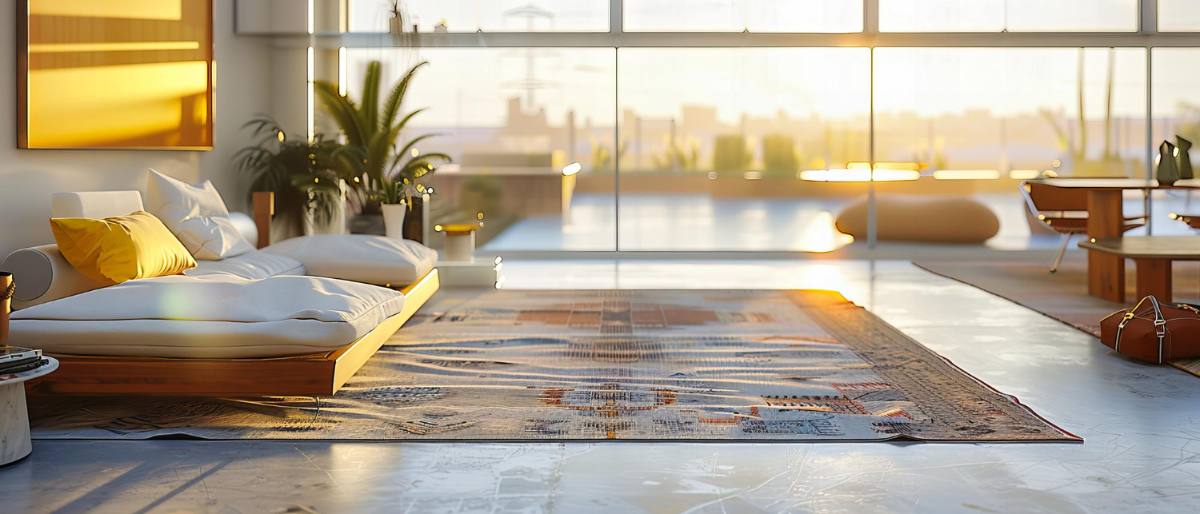
If you're searching for rugs in Dubai, the sheer choice can be overwhelming — hand-knotted Persian designs, machine-made modern pieces, natural sisal weaves, and everything from budget-friendly synthetics to investment-grade heirlooms, all sold at wildly different prices for what can look like the same thing online. This guide breaks down the real differences: what rug types are available in Dubai, how much you should expect to pay, what size fits your room, which materials actually hold up to Dubai's heat, sun and dust, and how to avoid overpaying for a rug that isn't what it claims to be.
What Types of Rugs Are Available in Dubai?
Dubai's rug market covers eight broad categories, and most homes end up mixing two or three of them across different rooms rather than picking just one.
- Persian & Oriental — hand-knotted, densely patterned, traditionally wool or silk; the most collectible and the most counterfeited category (see the construction section below).
- Turkish (kilim & flatweave) — flatwoven, reversible, lighter and often more affordable than knotted Persian pieces.
- Modern & abstract — geometric or minimalist patterns designed for contemporary apartments and villas.
- Shaggy — thick, high-pile, soft underfoot; popular for bedrooms and family living rooms.
- Sisal & jute — natural plant-fiber weaves; textured, earthy, often used in majlis or study areas.
- Custom & patchwork — bespoke sizing or mixed-fabric designs for irregular spaces or a bohemian look.
- Animal-print / faux fur — statement accent pieces, usually smaller format.
- Custom-sized rugs — cut and bound to an exact room measurement, common in villas with non-standard floor plans.
Browse the full range: Shaggy · Sisal · Area · Modern · Handmade · Patchwork · Animal Skin · Leopard rugs.
How Much Do Rugs Cost in Dubai?
Price is driven mainly by three things: construction (hand-knotted costs the most, machine-made the least), material (silk and wool cost more than synthetic fiber), and size. As a general Dubai market guide:
| Rug Category | Typical Size | Indicative Price Range (AED) |
|---|---|---|
| Machine-made synthetic (polypropylene/nylon) | Small–medium (1.5×2.3m) | 150 – 400 |
| Mid-range wool or wool-blend | Medium (2×3m) | 500 – 1,500 |
| Turkish flatweave / kilim | Medium (2×3m) | 600 – 2,000 |
| Hand-tufted wool | Large (2.4×3.4m) | 1,200 – 3,500 |
| Hand-knotted Persian/Oriental | Large (2.4×3.4m) | 2,500 – 12,000+ |
| Custom-sized or patchwork | Made to order | Quoted per project |
Beyond size and construction, knot density (for hand-knotted pieces), fiber quality, and country of origin all move the price within these bands — a showroom consultation is the fastest way to get an accurate quote for a specific room.
What Rug Size Do I Need for My Room?
The most common sizing mistake is buying a rug too small for the furniture around it. As a rule of thumb, a rug should either sit fully under all the furniture in a seating group, or be large enough that at least the front legs of each piece rest on it.

| Room | Recommended Rug Size |
|---|---|
| Living room (3-seater + 2 chairs) | 2.4 × 3.4 m or larger, all furniture front legs on the rug |
| Bedroom (queen/king bed) | 2 × 3 m, extending 45–60 cm beyond the sides and foot of the bed |
| Dining table (6 seats) | 2.4 × 3.4 m, extending 70 cm beyond the table on all sides so chairs stay on the rug when pulled out |
| Hallway / entrance | Runner, 0.7–1 m wide, leaving 15–20 cm of floor visible on each side |
For irregular rooms or open-plan villas, a custom-cut rug (see the Types section above) is usually a better fit than trying to make a standard size work.
Hand-Knotted vs Hand-Tufted vs Machine-Made: What's the Difference?
These three construction methods look similar in photos but differ enormously in durability, price, and how they age — and the terms are often used loosely (or incorrectly) in online listings, which is the single biggest reason buyers overpay.
| Construction | How It's Made | Durability | Relative Price |
|---|---|---|---|
| Hand-knotted | Each thread individually knotted onto a loom by hand; can take months per rug | Decades, often improves with age | Highest |
| Hand-tufted | Yarn punched through a fabric backing with a tufting gun, then a backing glued/sewn on | 5–15 years; backing can crack or shed over time | Mid |
| Machine-made | Woven by industrial loom in a fraction of the time | 5–10 years, consistent quality | Lowest |
A simple way to check construction in person: turn the rug over. A hand-knotted rug shows the same pattern clearly on the back; a hand-tufted rug has a fabric or latex backing hiding the knots; a machine-made rug has a uniform, mesh-like reverse.
Which Rug Material Suits Dubai's Climate Best?
Dubai's combination of intense sun, air-conditioned dryness, and fine airborne dust rules out some materials that work fine in cooler, more humid climates.
- Wool — naturally insulating and durable, but can trap dust; best in air-conditioned living/bedrooms rather than sun-facing rooms.
- Synthetic (polypropylene/nylon) — resists moisture, fading and staining; a practical choice for rooms with direct sun through floor-to-ceiling windows, common in Dubai apartments.
- Sisal & jute — breathable and textured, but natural fibers can absorb humidity; avoid in bathrooms or near balcony doors.
- Silk — striking sheen and detail, but the most sun- and wear-sensitive; best as a low-traffic accent piece away from direct light.
If a rug will sit in direct sunlight for part of the day, prioritize fade-resistant synthetic or wool-blend fiber over silk or unprotected natural dyes, and rotate the rug periodically (see below) to even out sun exposure.
How Do I Care for a Rug in Dubai's Heat and Dust?
Dubai's fine sand dust settles into rug fiber faster than in most climates, so a slightly more frequent care routine than you might be used to elsewhere pays off.
- Vacuum weekly on a low-pile setting — dust builds up faster here than in cooler, less arid climates.
- Rotate the rug 180° every 3–6 months to even out sun fade and foot-traffic wear.
- Schedule a professional deep clean every 12–18 months, especially for wool and hand-knotted pieces.
- Keep rugs slightly away from direct AC vents — constant airflow dries out natural fibers and can cause them to become brittle.
- Use a non-slip rug pad underneath, particularly on Dubai's common marble and polished-tile floors, both for safety and to stop the backing from degrading against hard, smooth stone.
Rugs or Wall-to-Wall Carpet: Which Should You Choose?
Rugs are the more flexible choice: lower upfront cost, easy to swap by season or when you move, and simple to have professionally cleaned off-site. Wall-to-wall carpet suits rooms where you want continuous warmth and sound insulation edge-to-edge — bedrooms, staircases, and home cinemas are the most common cases. Many Dubai homes use both: wall-to-wall carpet in bedrooms and stairs, area rugs over marble or tile in living and dining spaces. For a full cost and material comparison, see our wall-to-wall carpet guide.
Where to Buy Rugs in Dubai
Carpet Shop Dubai carries Persian and hand-knotted rugs, Turkish flatweave, modern and shaggy designs, sisal and jute weaves, and custom patchwork and made-to-measure rugs, alongside our wall-to-wall carpet and flooring ranges. Every order includes a free in-home consultation, so our design team can measure your room and bring physical samples before you commit — the most reliable way to judge color, texture and pile height, since screens rarely show true colour accurately.
We offer free delivery across Dubai and the wider UAE — most in-stock rugs arrive within 3 days of confirming your order (larger custom or made-to-measure pieces may take longer) — a 30-day return policy, and flexible payment by bank deposit, online transfer, cash in-store, cash on delivery, or installments through Tabby.
- Premium quality rugs, sourced and inspected before sale
- Free in-home consultation & measurement
- 30-day return policy
- Delivery within 3 days across Dubai & UAE
- Pay in installments with Tabby
Final Thoughts
Finding the right rug in Dubai comes down to matching construction and material to how the room is actually used — a busy hallway needs a different rug than a low-traffic formal living room. If you're not sure where to start, our design team can talk you through the options for your specific space.