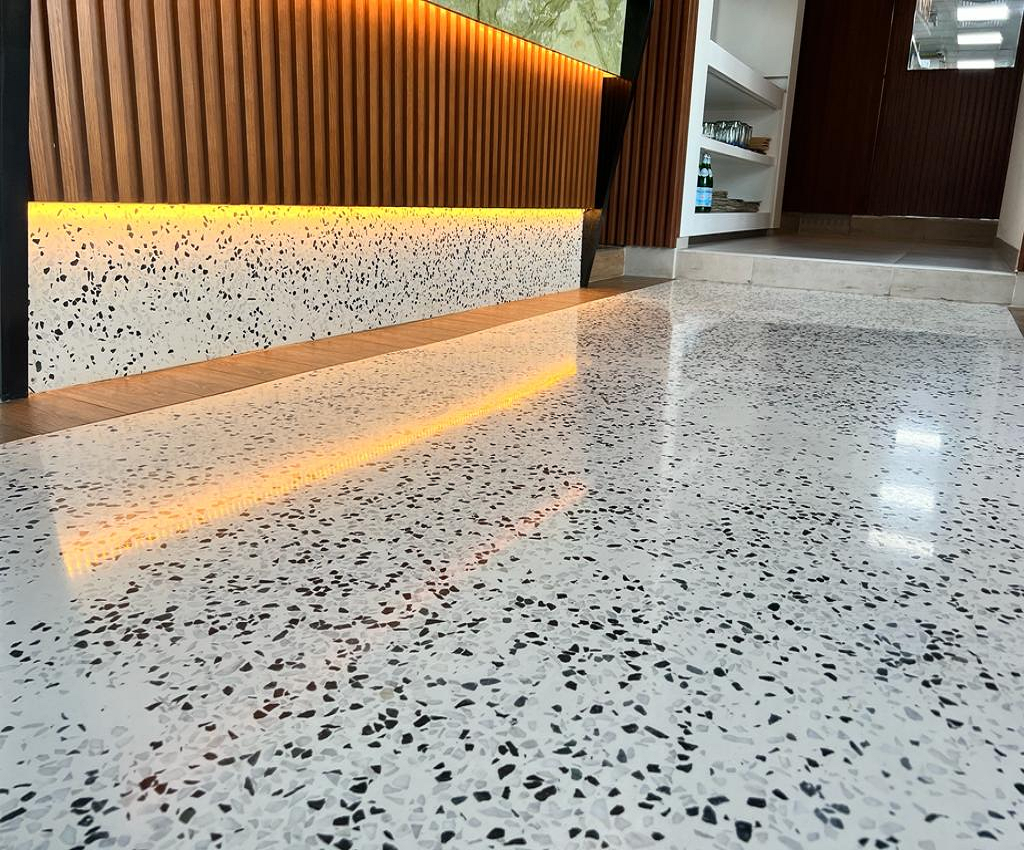
Epoxy Terrazzo : A Timeless Look Built for Modern Living
Epoxy terrazzo flooring is having a genuine moment in Dubai. Architects, hospitality designers, and luxury homeowners are rediscovering the beauty of marble chip-embedded floors ” but in a form that is stronger, more versatile, and far faster to install than the traditional cement-based version. At Stone Carpet , our epoxy terrazzo flooring service covers everything from initial design and aggregate selection through to final polishing and handover, giving you a completely bespoke floor that no tile or wood product can replicate. You can explore our epoxy terrazzo flooring service page for more details.
What Is Epoxy Terrazzo Flooring?
Epoxy terrazzo is a floor system built from two components: a two-part epoxy resin matrix and decorative aggregate, typically marble, glass, granite, or shell chips. The aggregate is mixed into the resin, trowelled onto a prepared concrete substrate, and allowed to cure. Once hard, the surface is mechanically ground through progressively finer diamond grits until the aggregate faces are fully exposed and the floor is smooth. A final polish or seal brings the surface to the specified gloss level.
The critical difference between epoxy terrazzo and traditional cement terrazzo is the binder. Epoxy resin is approximately three times stronger than cement, bonds more completely to the aggregate, cures in a fraction of the time, and does not shrink during curing. That last point is especially significant: cement terrazzo shrinks as it cures and requires divider strips every few metres to control cracking. Epoxy terrazzo has near-zero shrinkage, which means large open-plan floors can be installed as a single continuous surface with no visible joints.
Aggregate and Chip Options for Epoxy Terrazzo
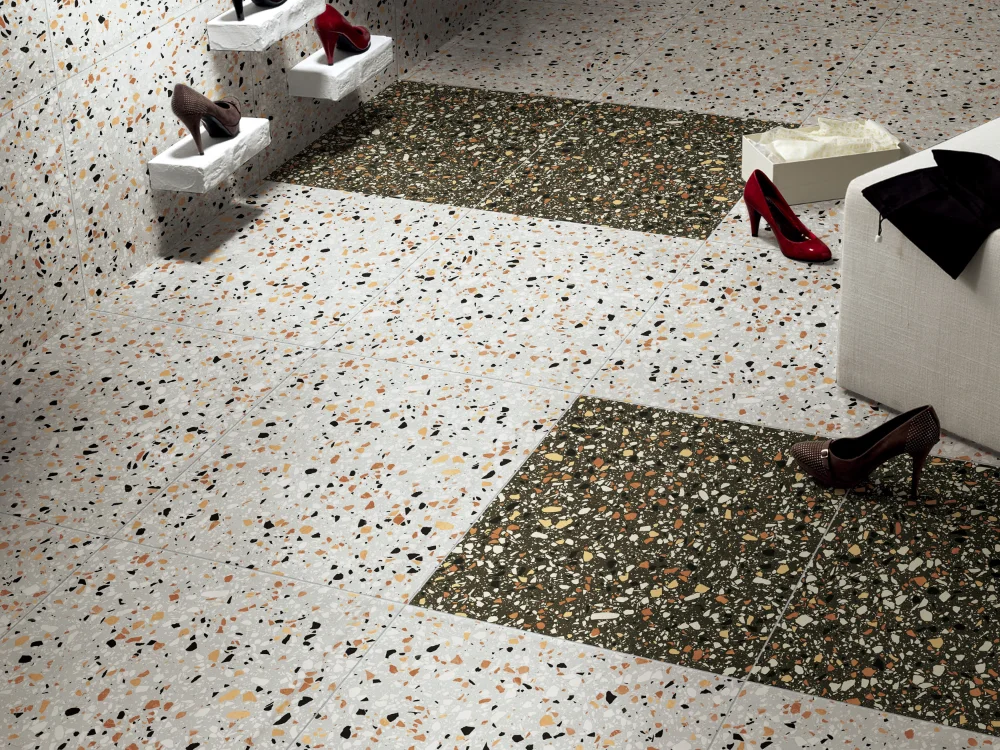
The aggregate is where your floor's character comes from. Every material, size, and combination produces a completely different visual result. Our aggregate library includes:
- Carrara White Marble: The classic terrazzo material — fine white pieces that produce a bright, clean surface suitable for any interior style.
- Calacatta Marble Chips: Warmer white with distinctive grey veining, ideal for high-end residential floors and hotel lobbies.
- Coloured Marble Chips: Available in green, red, black, ochre, and rose. Pairs naturally with our interior design services for a fully coordinated room finish.
- Recycled Glass Aggregate: Translucent and coloured glass pieces in multiple sizes. Under directional lighting, glass chips create brilliant flashes of colour that change with viewing angle.
- Mirror Chips: Reflective cut mirror fragments broadcast at controlled densities for a glamorous, high-contrast surface in luxury retail and hospitality settings.
- Mother of Pearl Shell: Iridescent shell chip that shifts colour from cream to champagne to soft pink depending on the light angle.
- Granite and Quartzite: Harder and heavier than marble, suited to the highest-traffic commercial floors where durability takes priority over delicacy.
- Custom Blend: Two or more aggregate types combined in a single matrix pigmented to your specification. The only limit is the design brief.
Technical Specifications
| Specification | Detail |
|---|---|
| System Thickness | 6mm to 12mm total installed depth depending on aggregate size and chip loading. |
| Chip Size Options | Fine grade 0 to 3mm / Medium grade 3 to 6mm / Coarse grade 6 to 12mm. |
| Resin Matrix | 100 percent solids epoxy, zero VOC formulation during application. |
| Compressive Strength | Greater than 85 MPa after full cure at 28 days. |
| Tensile Bond Strength to Concrete Substrate | Greater than 2.0 MPa pull-off. |
| Grinding Process | Diamond tooling from 30 grit rough grind through to 400 to 800 grit finish polish. |
| Surface Finish Options | Matt honed / Satin / High gloss polished / Mirror polish. |
| Thermal Compatibility | Near-identical thermal expansion to concrete; suitable for underfloor heating systems. |
| Slip Resistance | Honed finish R10; polished finish requires anti-slip treatment for commercial compliance. |
💬 WhatsApp +971 56 584 7696 to Request Aggregate Samples and a Design Mock-Up
WhatsApp NowEpoxy Terrazzo vs Cement Terrazzo: Key Differences
Both systems use aggregate chips in a binder matrix, but the performance differences are substantial:
| Cement Terrazzo | Epoxy Terrazzo |
|---|---|
| Expansion joints required every 1.5 to 2 sq.m. to control shrinkage cracking. | Near-zero shrinkage — continuous open-plan floors of any size with no visible joints. |
| Requires 28 days of cure before grinding can begin. | Reaches grinding hardness in 24 to 48 hours. |
| Colour range limited by the alkaline chemistry of the cement matrix. | Accepts virtually any pigment — vibrant and deep colours impossible in cement. |
| Requires 12 to 20mm thickness. | Achieves the same result at 6 to 12mm — saves weight and protects floor-to-ceiling height. |
| Compressive strength typically 30 to 45 MPa. | Compressive strength above 85 MPa — approximately twice as strong. |
| Longer timeline increases labour and site-on costs. | Faster to complete — reduces site costs, partially offsetting the higher material cost. |
Where Epoxy Terrazzo Is Installed in Dubai
Hotel lobbies and public areas represent the highest-profile epoxy terrazzo applications in Dubai. The continuous seamless surface is perfectly suited to grand lobbies where visual impact matters and grout lines or tile breaks would interrupt the design intention. Five-star properties on Palm Jumeirah, in Downtown Dubai, and at DIFC are among the venues where epoxy terrazzo has become the floor of choice for arrival areas.
Luxury residential villas in Emirates Hills, Jumeirah Bay Island, and Dubai Hills Estate use epoxy terrazzo as an alternative to large-format marble tiles. The absence of grout joints and the ability to embed family monograms, geometric borders, or custom chip mixes make it a highly personal floor choice for high-net-worth residential projects.
Branded retail boutiques, fine dining restaurants, corporate headquarters, and spa reception areas are other active markets in Dubai. Our team also regularly combines epoxy terrazzo with complementary finishes such as wooden flooring in adjoining areas, or wall cladding services to create a fully designed interior across every surface.
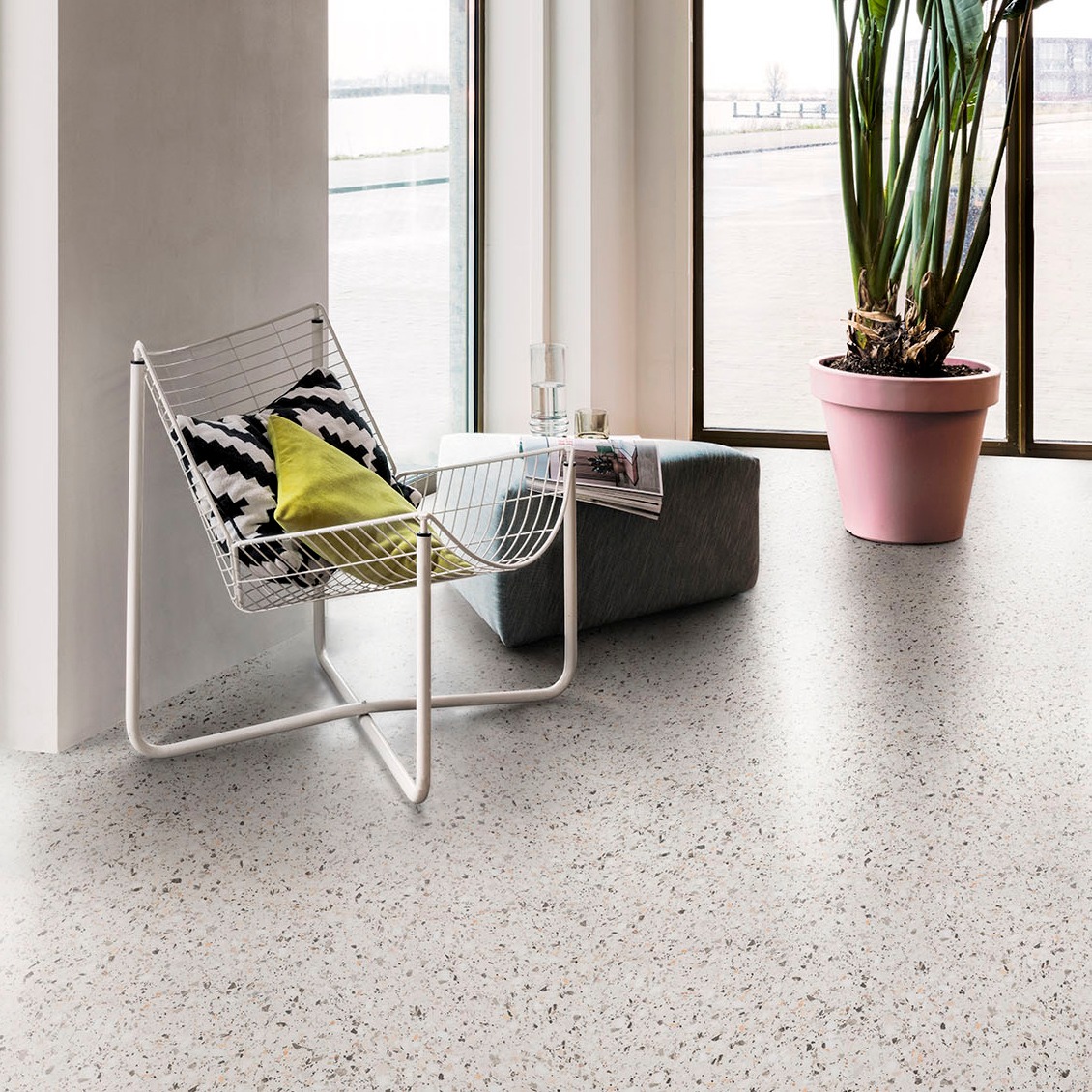
The Epoxy Terrazzo Installation Process
Design Consultation and Sample Board
Every epoxy terrazzo project begins with a design session. We present aggregate samples, chip size options, matrix pigment colours, and surface finish choices. Once a design direction is agreed, we prepare a physical sample board using your exact aggregate and matrix specification, so you can see and touch the real result before any floor work begins. Amendments can be made at this stage with no cost or delay implications.
Substrate Preparation
The concrete base is diamond-ground to remove laitance, existing sealers, and surface contamination. Any cracks, control joints, or weak areas are cut out and repaired with epoxy mortar. The surface is then profiled to the correct roughness for maximum bond strength. Moisture testing is carried out and any readings above the acceptable threshold are addressed with a moisture-tolerant primer system.
Priming
A low-viscosity, zero-VOC epoxy primer is roller-applied across the prepared substrate. The primer penetrates the concrete pores, seals the surface against outgassing, and provides a chemically compatible base for the terrazzo matrix to bond to. Full primer cure is confirmed before proceeding.
Divider Strip Installation (Where Specified)
If the design includes geometric patterns, medallions, company logos, or colour zone separations, brass, aluminium, or zinc divider strips are fixed to the primed substrate at this stage. These create the outlines of each design element and separate different aggregate mixes within the same floor.
Terrazzo Matrix Application
The aggregate-epoxy mixture is prepared in accurately measured batches to ensure consistency of aggregate loading and matrix colour across the entire floor. The mixture is trowel-applied to the substrate and compacted to remove voids. Multiple passes ensure even aggregate distribution and correct system thickness throughout.
Initial Grind
After a minimum curing period of 24 to 48 hours, the surface is ground with coarse diamond tooling to flatten the matrix surface and fully expose the aggregate faces. This grind removes the resin skin over the chips and reveals the decorative aggregate that gives the floor its character.
Progressive Polishing
Further grinding passes using progressively finer diamond grits refine the surface. Each pass removes the scratch marks from the previous one. The number of grits used depends on the specified finish: a honed commercial floor requires fewer passes than a mirror-polished residential floor.
Sealing and Final Finish
A penetrating epoxy or polyurethane sealer is applied to close the polished surface. For high-gloss or mirror finish requirements, a final crystallisation or burnishing treatment is applied. The floor is cleaned and protected before client handover.
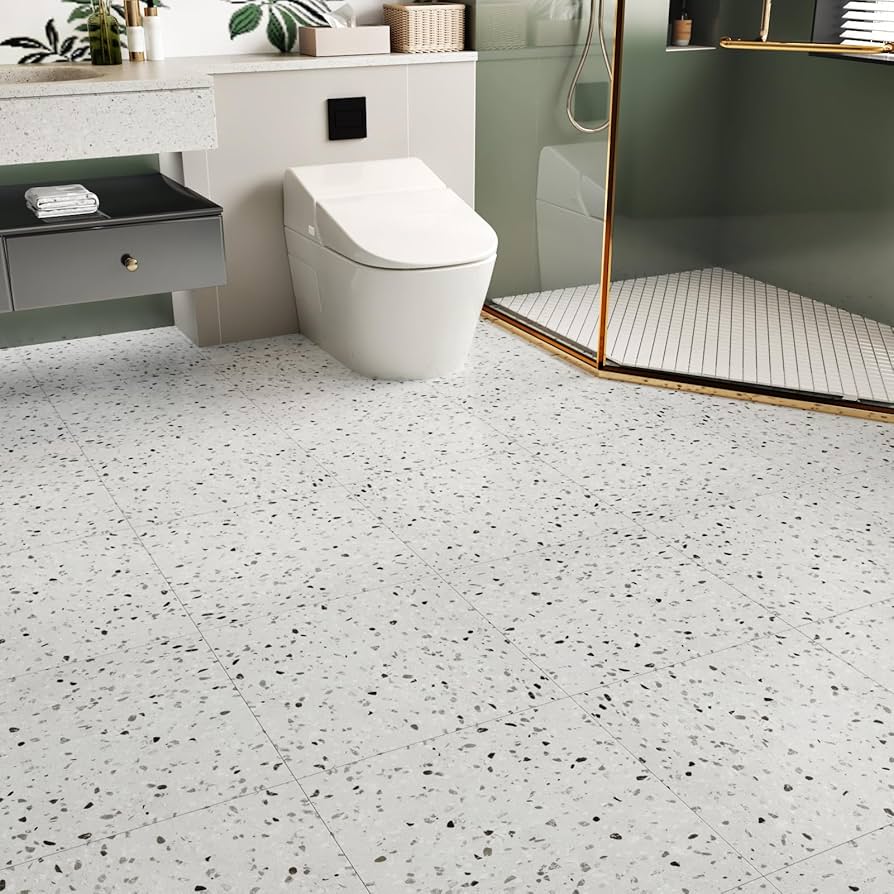
Epoxy Terrazzo Flooring Cost in Dubai
Pricing varies based on aggregate choice, floor area, pattern complexity, and specified finish. As a guide:
All prices include the design consultation, physical sample board, full installation, and grinding and polishing to the agreed finish specification. For large commercial or hospitality projects, volume pricing applies. Contact us to discuss your specific scope and timeline.
Caring for Your Epoxy Terrazzo Floor
Epoxy terrazzo is one of the lowest-maintenance floor finishes available, but a simple routine will keep it looking exceptional for decades:
- Daily: Dust-mop or sweep to remove grit particles that could scratch the polished surface under foot traffic.
- Weekly: Damp mop with warm water and a pH-neutral cleaner. Avoid acidic or alkaline cleaners, which can dull the sealer finish over time.
- Monthly: Inspect for any areas where the sealer appears to be losing its sheen under heavy traffic and address early.
- Every 2 to 3 years: Apply a fresh coat of penetrating sealer to maintain the surface protection and refresh the gloss.
- Every 10 to 15 years: A professional re-grind and re-polish can return any epoxy terrazzo floor to its original installed condition, making it one of the most renewable flooring systems available.
Benefits of Epoxy Terrazzo Flooring
- No expansion joints means a continuous, unbroken surface across floors of any size.
- Custom aggregate and pigment combinations make every floor genuinely unique.
- Stronger than natural marble or cement terrazzo, with greater resistance to chipping and impact.
- The high-gloss polished surface reflects light beautifully, making spaces feel larger and brighter.
- Compatible with underfloor heating, making it comfortable year-round in Dubai's air-conditioned interiors.
- Fully repairable and restorable by re-grinding: the floor can be renewed rather than replaced.
- Aggregate options include recycled glass and reclaimed marble, making it a viable choice for sustainable design projects.
- Suitable for indoor and covered outdoor areas including entrance canopies and shaded terraces.
Frequently Asked Questions About Epoxy Terrazzo in Dubai
How long does epoxy terrazzo flooring last?
Can epoxy terrazzo be installed in a bathroom or wet room?
How does epoxy terrazzo feel underfoot?
Can company logos or custom patterns be built into the floor?
Is epoxy terrazzo suitable for outdoor use in Dubai?
How do you repair a damaged epoxy terrazzo floor?
What is the minimum floor area for an epoxy terrazzo installation?
Start Your Epoxy Terrazzo Project in Dubai Today
Carpet Shop Dubai has been delivering bespoke flooring solutions across Dubai and the UAE for over 15 years. Our epoxy terrazzo installations are completed entirely in-house, with no subcontracting, giving you direct accountability and consistent quality from start to finish. Our showroom in Al Quoz holds a physical library of aggregate samples and finished mock-up boards for you to view and compare before committing to a design. We work with homeowners, interior designers, fit-out contractors, and developers at every scale. For a broader view of what we offer across flooring and interior surfaces, visit our flooring services page.